
Interested Government Agency Waiver for J-1 Physicians Sponsored by ECFMG
International physicians completing their residency or fellowship training in J-1 status sponsored by ECFMG are automatically subject to the Department of State's requirement that they return to their home country for two years (sometimes known as "212e") before continuing their career in the US unless they obtain a waiver of this requirement. IFSIS will connect hiring departments with outside counsel to obtain an "interested government agency" (IGA) waiver of the two-year home residence requirement. We generally sponsor subspecialty waivers only through the Conrad/State 30 program (generally 4-8 available per year) and the Southeast Crescent Regional Commission (unlimited and year-round, but for placement at physical work locations in Montgomery County ONLY). In rare circumstances, UAB and HSF will consider waiver sponsorship via the Appalachian Regional Commission (ARC) or the Delta Regional Authority (DRA). Sponsorship with the latter two agencies will proceed only after an exhuastive internal evaluation of need and three years of past utilization data and a determination of the county in which the physician will be physically working for 40 hours per week. If your international candidate will be practicing in primary care (i.e., family practice, internal medicine, general pediatrics, or OB/GYN) or psychiatry, we will instead sponsor a waiver through the US Department of Health and Human Services (HHS). Read more about each waiver program below.
All waiver applications are assembled, prepared, and filed by outside counsel — not the IFSIS office. IFSIS will connect the hiring department and outside counsel to identify the best waiver option for your candidate according to timing and institutional need. Once a waiver program has been identified and your candidate has signed an offer letter, you will work directly with outside counsel on the waiver process. IFSIS will work with you in parallel to collect documents needed for the subsequent H-1B work authorization process specifically, and IFSIS will file the H-1B petitions for work authorization after the physician's waiver is approved. Please see the flowcharts below to help set expectations for the J-1 waiver process and attend our webinar on Zoom in February for questions specifically about the process.
IGA waivers require physicians to commit to working in an underserved area or with an underserved medical population for a minimum of three years before applying to become a permanent resident. Physicians cannot apply for more than one IGA waiver at the same time. Due to uncertain processing times with the various federal agencies, IFSIS strongly recommends that candidates extend their DS-2019 for boards by filing a request online with ECFMG to allow the waiver process the maximum time to conclude. Physicians should consult their current institution's ECFMG Training Program Liaison (TPL) or ECFMG directly with questions about the DS-2019 extension process. IFSIS cannot assist.
Conrad 30 (a/k/a "State 30" or ADPH waivers)
The Alabama Department of Public Health (ADPH) administers the Conrad 30 J-1 waiver program; specifics and a complete documentation checklist can be found here. Under this program, there are only 30 slots available for J-1 waiver sponsorship statewide. At least ten slots are reserved for primary care and psychiatry, with the remaining 20 available (but not guaranteed) for subspecialties, if not used for additional primary care and psychiatry applications. ADPH accepts applications for the 30 slots in two rounds: primary care on October 1 each year, and subspecialties on the first Monday of the first full work week in January each year. This means that waiver application packets must be completed and ready to deliver to the ADPH on those dates. There are no county-specific restrictions on this waiver program. Read more about the Conrad 30 requirements here: https://www.alabamapublichealth.gov/ruralhealth/j1visa.html
Each employer (i.e., UAB and HSF) is initially limited to only two subspecialty requests. If any of the 30 slots are still unused by approximately late March or April (there is no specific date), ADPH will allow employers to submit two additional J-1 waiver applications. ADPH grants subspecialty waivers on a first-come, first-served basis based on documentation of community need. Again, specifics and a complete documentation checklist can be found here. UAB and HSF hold an internal nomination process in July to determine Conrad waiver slots based on department/division need. IFSIS will notify departments/divisions when the nomination process is open and will provide a nomination form and checklist. The review committee aims to make its decision by early August each year so that the Conrad process can begin as soon as possible for the January round of four initial applications.
Southeast Crescent Regional Commission (SCRC) Waivers
This federal waiver program is limited to international physicians who will physically work for an average of 40 hours per week specifically in one of only nine southern Alabama counties: Autauga, Baldwin, Coffee, Covington, Crenshaw, Dale, Geneva, Henry, Houston, Lee, Mobile, Montgomery, and Pike. In practice, this program is relevant only for physician placement at the UAB Multispecialty Clinic in Montgomery. SHELBY AND JEFFERSON COUNTIES ARE NOT VALID PLACEMENT LOCATIONS. Read more about the SCRC waiver requirements here: https://scrc.gov/programs/. These waivers are generally reviewed within 60 days for a $3,000 application fee.
Department of Health and Human Services (HHS) Waivers
HHS sponsors unlimited J-1 waivers ONLY for hospitalists and primary care physicians. This program does not accept physicians who are more than 12 months beyond their residency training. In other words, to be eligible for this type of waiver, the candidate cannot have completed any fellowship training prior to their UAB/HSF appointment as clinical faculty. There are no county-specific restrictions on this waiver program. Read more about the HHS waiver requirements here: https://www.hhs.gov/about/agencies/oga/about-oga/what-we-do/visitor-exchange-program/supplementary-b-clinical-care.html
Appalachian Regional Commission (ARC) Waivers
This waiver program was designed for and prefers hospitalists/primary care physicians. However, the ARC will entertain waiver applications for subspecialists if and only if the institution can show three-year past service data meeting specific thresholds for service to Medicare, Medicaid, and medically indigent patient populations, in addition to the usual statement of need and a justification for any deviance from meeting the three-year thresholds. ARC waiver applications will be considered only after careful, exhaustive scrutiny and internal evaluation of institutional data pertaining to the specific department/division in question, in consultation with outside counsel. ARC waiver applications undergo a first-pass review and signature process with the ADPH in Montgomery before being forwarded to ARC for next-level federal review. The ARC closes every August for internal audit, adding processing time. (The application must still then undergo Department of State and Department of Homeland Security/USCIS review as well after ARC recommends the waiver.) This waiver program is available for physicians who will physically work for an average of 40 hours per week specifically in the following Alabama counties covered by the ARC footprint: Bibb, Blount, Calhoun, Chambers, Cherokee, Chilton, Clay, Cleburne, Colbert, Coosa, Cullman, De Kalb, Elmore, Etowah, Fayette, Franklin, Hale, Jackson, Jefferson, Lamar, Lauderdale, Lawrence, Limestone, Macon, Madison, Marion, Marshall, Morgan, Pickens, Randolph, St. Clair, Shelby, Talladega, Tallapoosa, Tuscaloosa, Walker, and Winston. Read more about the ARC waiver requirements here: https://www.arc.gov/j-1-visa-waivers/
Delta Regional Authority (DRA) Waivers
This federal waiver program is available for candidates who will physically work for an average of 40 hours per week specifically in the following Alabama counties: Barbour, Bullock, Butler, Choctaw, Clarke, Conecuh, Dallas, Escambia, Greene, Hale, Lowndes, Macon, Marengo, Monroe, Perry, Pickens, Russell, Sumter, Washington, and Wilcox. SHELBY AND JEFFERSON COUNTIES ARE NOT VALID PLACEMENT LOCATIONS. It is unlimited and open to all subspecialties. If your candidate will not physically work in these counties as described above, they are not eligible for this waiver program.
If Your Candidate Does Not Receive a Waiver
If it appears that the candidate's waiver will not be approved in time to preserve the anticipated start date for H-1B employment, IFSIS can evaluate the CV for potential O-1 work authorization. O-1 sponsorship will be evaluated on a case-by-case basis and is not guaranteed. Even if USCIS approves O-1 work authorization for a candidate while the waiver process is ongoing, the department will still need to pay additional USCIS filing fees and file H-1B work authorization petitions after the waiver is approved so that the candidate can begin the three required years of service specifically in H-1B immigration status required by the regulations. Time worked while in O-1 status does not "count" toward the three required years of waiver service. Read more about the O-1 process here: https://www.uab.edu/global/faculty-staff/international-faculty-staff/o-1-work-authorization.
J-1 Waiver Compliance Forms
The above waiver programs require sponsored physicians and sponsoring employers to submit verification forms during the first week of waiver service employment and every six months thereafter until the physician completes three full years of waiver service in H-1B status. The date of waiver service is calculated from the first day of employment with the waiver-sponsoring employer (i.e., UAB if UAB sponsored the waiver and HSF if HSF sponsored the waiver). Please docket these submission dates on your Outlook calendar or preferred task-tracking software. Forms for each of the programs can be found at the links below.
Conrad 30 waiver form: https://www.alabamapublichealth.gov/ruralhealth/assets/state_30_phys_status_rpt_fillableform.pdf
ARC waiver forms: https://www.arc.gov/wp-content/uploads/2024/04/J-1-Visa-Placement-Verification-Form.pdf (due the first week of the physician's employment in H-1B status) AND https://www.alabamapublichealth.gov/ruralhealth/assets/state_30_phys_status_rpt_fillableform.pdf (for every six months thereafter until the physician completes three years of H-1B employment)
SCRC waiver forms: https://scrc.gov/sites/default/files/2024-04/j-1-waiver-compliance-guidelines.pdf (due June 15 and December 15 annually regardless of waiver service employment start date)
DRA waiver forms: https://dra.gov/wp-content/uploads/2023/03/8._Physician_Employment_Verification_Form_2.pdf (due the first week of the physician's employment in H-1B status AND every six months thereafter until the physician completes three years of H-1B employment):
https://dra.gov/wp-content/uploads/2023/03/9._Physician_Compliance_Survey_Employer_2.pdf
https://dra.gov/wp-content/uploads/2023/03/10._Physician_Compliance_Survey_Employee.pdf
Email all verification forms to
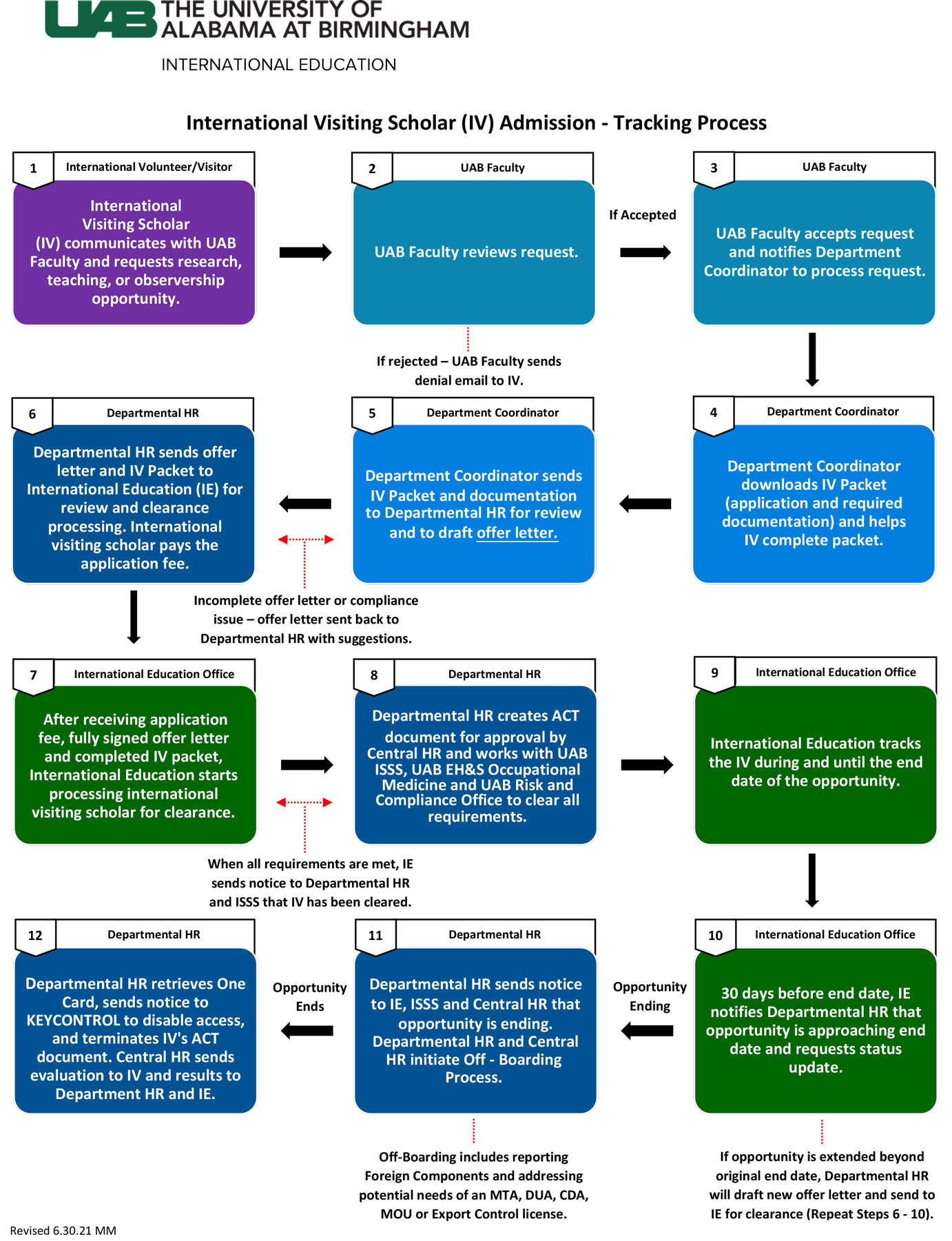
- International Volunteer/Visitor: International Visiting Scholar (IV) communicates with UAB faculty and requests research, teaching, or observership opportunity.
- UAB Faculty: UAB faculty reviews request.
- If rejected, UAB faculty sends denial email to IV.
- UAB Faculty: If accepted, UAB faculty accepts requests and notifies department coordinator to process request.
- Department Coordinator: Department coordinator downloads IV packet (application and required documentation) and helps IV complete packet.
- Department Coordinator: Department coordinator sends IV packet and documentation to Departmental HR for review and to draft offer letter.
- Incomplete offer letter or compliance issue: Offer sent back to Departmental HR with suggestions.
- Departmental HR: Departmental HR sends letter and IV packet to International Education (IE) for review and clearance processing. International visiting scholar pays the application fee.
- International Education Office: After receiving application fee, fully signed offer letter, and competed IV packet, IE starts processing international visiting scholar for clearance.
- When all requirements are met, IE sends notice to Departmental HR and ISSS that IV has been cleared.
- Departmental HR: Departmental HR creates ACT document for Central HR and works with UAB ISSS, UAB EH&S Occupational Medicine, and UAB Risk and Compliance Office to clear all requirements.
- International Education Office: IE tracks the IV during and until the end date of the opportunity.
- International Education Office: 30 days before end date, IE notifies Departmental HR that opportunity is approaching end date and requests status update.
- If opportunity is extended beyond original date end, Departmental HR will draft a new letter and send to IE for clearance (repeat steps 6-10).
- Departmental HR: Departmental HR sends notice to IE, ISSS, and Central HR that opportunity is ending. Departmental HR and Central HR initiate off-boarding process.
- Off-boarding includes reporting components and addressing potential needs of a MTA, DUA, CDA, MOU, or Export Control license.
- Departmental HR: Departmental HR retrieves One Card, sends notice to KEYCONTROL to disable access, and terminate IV's ACT document. Central HR sends evaluation to IV and results to Department HR and IE.
IME and Immunization Clearance (CLINICAL SPACE ONLY)
If your prospective exchange visitor will not have access to UAB Hospital or any other clinical setting, please proceed to the next step.
If your prospective exchange visitor will have access to the OR, animal labs, or any clinical setting, please send a copy of the offer/invitation letter to International Medical Education (IME) for appropriate clearance first. IME controls the number of individuals allowed in UAB clinical spaces and is responsible for ensuring that the immunization and workplace safety protocols are followed. It can take approximately 90 days to clear IME and receive the immigration document necessary for the exchange visitor to enter the US.
-
What Documents are Needed: Initial Appointment – 20-21 Postdocs
We cannot issue the DS-2019 until we receive all the documents and forms from the Exchange Visitor and the Department. We request to receive ALL documents at least 2 months before the desired start date.
As the Department inviting the Exchange Visitor on campus, you are responsible for providing:
 International EV appointment packet completed and signed
 - Offer letter: please provide the letter from the Office of Postdoctoral education
The Department remains responsible to create a profile in Oracle and check the I-9 (Employment Eligibility Verification document) with HR or our office.
This email address is being protected from spambots. You need JavaScript enabled to view it. for more information about I-9. -
What documents are needed: Initial Appointment – 02-04-60 Others
Request can now be made for International Visitors appointed in 02 Temporary, 04 Irregular, and 60 Volunteer positions with a start date of 8/23/2021 or later. Read general information about these categories.
For those who will be coming in J-1 status, please FIRST contact International Education (IE) in the Office of the Provost (
This email address is being protected from spambots. You need JavaScript enabled to view it. ). You can also see an overview of the process.After IE gives its greenlight, you can complete:
-
What Documents are Needed: Extension
If the J-1 scholar is currently in 02/04 or 60 status, please contact
This email address is being protected from spambots. You need JavaScript enabled to view it. .J-1 Research Scholars and Professors can remain in the US for a maximum of 5 years. The position held at UAB must remain compliant with the J-1 regulations to seek an extension.
J-1 Short-Term Scholars can remain in the US for a maximum of 6 months. No extension beyond the 6 months can be granted.
J-1 Student Interns can remain in the US for a maximum of 12 months per degree.
To request an extension, please contact our office at least 1 month before the current end date as listed on the DS-2019. Please note that this end date is the last day the Exchange Visitor will be authorized to work on UAB campus. ISSS office will need:
- J-1 Reappointment Packet (pdf) - to be completed by UAB department
- Extension offer letter – to be issued by UAB – the extension letter must list the new dates of appointment, the subject of the research (it should be the same as before) and the salary.
- Postdoctoral fellows – you can request an extension letter from the Office of Postdoctoral Education (OPE)
- Other – as indicated before, please contact ISSS J-1 advisors for additional instructions
- Proof of Funding
- Postdoctoral fellows – OPE letter is sufficient – be sure to list the source of funding on the reappointment form
- Other – to be discussed with ISSS
- Proof of continuous health insurance – to be provided by the Exchange Visitor for him/herself and his/her family (if any).
Once the DS-2019 is extended, the Exchange Visitor is authorized to stay in the US and continue to work.
The Department remains responsible to update Oracle and check the I-9 (Employment Eligibility Verification document) with HR or our office.
This email address is being protected from spambots. You need JavaScript enabled to view it. for more information about I-9. -
What Documents are Needed: Transfer within UAB
If an J-1 Exchange Visitor transfers lab within UAB, ISSS Office must ensure that the transfer complies with the Federal Regulations and update the government database SEVIS to reflect the correct appointment. Please contact ISSS Office immediately at
This email address is being protected from spambots. You need JavaScript enabled to view it. with the subject “J-1 scholar – lab transfer.”ISSS will assess the situation and collect the appropriate documents.
After the SEVIS record is updated, ISSS will issue and updated form DS-2019 for the J-1 Exchange Visitor and his/her family (if any).
The Department remains responsible to update Oracle and check the I-9 (Employment Eligibility Verification document) with HR or our office.
This email address is being protected from spambots. You need JavaScript enabled to view it. for more information about I-9. -
Five-Point Letter
As a Research Scholar, Professor, Short-Term Scholar or Student Intern, the Exchange Visitor is normally NOT authorized to have patient contact.
However, in certain cases, an Exchange Visitor physician participating in a program of observation, consultation, teaching or research may need to have limited patient contact in order to carry out those objectives. If the patient contact is incidental to those objectives, a physician participating in a non-clinical exchange program can engage in incidental patient contact.
Example of acceptable activities:
- doing a diagnostic examination in the presence of a senior physician who repeats the examination or ensures at every step that it is done correctly and the proper diagnostic information is obtained;
- being present during therapies and treatment with opportunities for hands on experience in ways that do not compromise the care of the patient;
- being present in the operating room and having limited patient contact, but not performing procedures.
If the Exchange Visitor needs to be authorized to have incidental patient contact, we need to collect a specific document called Five-Point Letter, signed by the Faculty Sponsor, the Faculty Chair and the Dean of the School of Medicine or his designee. The letter will specifically define the boundaries of the authorized patient contact.
Please contact the ISSS Office if you need to get such a letter.
-
When Can the Exchange Visitor Be on Campus?
Exact start dates can be hard to pinpoint. ISSS must receive all forms and documents AT LEAST 2 MONTHS prior to the exchange visitor’s scheduled start date at UAB.
ISSS can issue the DS-2019 approximately two weeks after receiving ALL necessary documents from both the exchange visitor and the department. Once we generate the DS-2019, the exchange visitor can go online and book a visa interview appointment at a US embassy or consulate abroad. Visa appointment wait times vary widely depending on the time of year and the embassy or consulate chosen. Wait times can be viewed on the Department of State website.
It can take a week or so to receive the visa after the appointment, and some exchange visitors may be selected for administrative processing (more information about administrative processing is available on the Department of State website – scroll to get to the appropriate question). A good rule of thumb is to plan on a start date and then add 30 days. In case of an unforeseen event, we may be able to change the dates, however, the start date listed on the DS-2019 is meant to be a firm start date at UAB.
The Exchange Visitor may enter the US up to 30 days before or after the start date listed on the DS-2019. We advise that they arrive about 1 or 2 weeks early to get settle and accomplish various administrative tasks before starting their research or internship.
-
How Much Will It Cost?
For appointments in 02 temporary, 04 irregular or 60 volunteer HR categories, there will be a cost of $350 attached to the IE clearance process. Please contact
This email address is being protected from spambots. You need JavaScript enabled to view it. for more details.There is still no costs to issue the form DS-2019 unless the department wishes to reimburse the exchange visitor for the cost of the:
- J-1 SEVIS fee (or I-901 fee) – this fee is only paid once for initial J-1
- Visa application fee – this fee is due every time the Exchange Visitor applies for a new visa at the US Consulate/Embassy. Please see the difference between visa vs. immigration status on the International Exchange Visitors J-1 FAQ web page.
- and/or English Proficiency Test fee
-
After the DS-2019 Is Generated
We ship the DS-2019 and a pre-arrival packet of information to the exchange visitor using the departmental UPS/FedEx account. Exchange visitors must present the blue-ink signed hard copy DS-2019 at their visa appointment at a US embassy or consulate abroad in order to obtain a J-1 visa to enter the US.
The Department is responsible to create the ACT document in Oracle and request a dummy SSN to the financial affairs. Our office can assist for the I-9 (please
This email address is being protected from spambots. You need JavaScript enabled to view it. for more information).Please keep in touch with the Exchange Visitor and ISSS Office about the arrival in the US so we can schedule an Orientation.
The Educational Commission for Foreign Medical Graduates (ECFMG) is the only institution approved by the US Department of State to issue the immigration document necessary for international medical graduates (IMGs) to enter or remain in the US on J-1 exchange visitor visas in the "Alien Physician" category to participate in clinical training for residencies and fellowships. ECFMG requires each host institution to designate Training Program Liaisons (TPLs) to be trained to coordinate the immigration process among stakeholders.
UAB’s TPLs work closely with residency and fellowship Program Directors and IMGs to ensure that all information is uploaded to the ECFMG portal to facilitate the timely arrival of J-1 residents and fellows. ECFMG dictates ALL requirements. ISSS cannot change the timing, order, or documents requested and serves only as a required liaison between ECFMG, GME, the UAB program, and the IMG.
IMGs hold J-1 immigration status pursuant to a Form DS-2019 just like J-1 Research Scholars—they are just in a different J-1 category that permits direct clinical contact during graduate medical education. There are many steps involved in obtaining a Form DS-2019, and all of them are controlled by ECFMG. Unlike for J-1 Research Scholars, ISSS cannot generate Form DS-2019 for J-1 residents and fellows: only ECFMG can. Everything is dependent on ECFMG.
-
Initial J-1 Application
The physicians that are not in the US yet need to submit an initial application. The general process is as below:
- UAB Department/Program initiates contact with ISSS to inform us of incoming international physicians.
- Depending on each individual situation, the Program and the physician will provide the required documents – see the table below to access the checklist that fits each specific situation.
- ISSS reviews the documents provided.
- ISSS creates an online Appointment Profile on UAB’s TPL portal (EVNet) and uploads supporting documents.
- ECFMG emails physicians to complete their part of application online and pay administrative fees through their portal (OASIS).
- After the application is completed and the fees paid, ECFMG issues the Form DS-2019 within 4-6 weeks.
- ECFMG sends the DS-2019 to ISSS (the DS-2019 is the form the physician must present at a US consulate to obtain a J-1 visa).
- ISSS contacts physician to collect the DS-2019 (or mails the DS-2019 to the physician, if the physician is outside the US).
Things to remember:
- Inform ISSS if the program is ACGME accredited or not;
- Inform ISSS if the physician will be paid by both HSF and UAB;
- The contract or offer letter must list the following information:
- Exact title of the fellowship
- Start and end dates – ECFMG review the application on a yearly basis
- PGY level
- Salary – if the physician will be paid by both UAB and HSF, the repartition between the 2 institution must be listed
-
Continued J-1 Application
Physicians that are already sponsored by ECFMG (even if they are coming from another institution in the US) are considered to continue their training. The process is pretty similar to the initial process.
Please note that ISSS Office is able to start the extension process before the new salaries for the upcoming year are published. However, it is always best practice to wait for the new salaries to be released by the GME Office. If the Physician requires an early extension, please be aware that ECFMG will not issue the new DS-2109 more than 6 months before the end of the current one (example – if the current DS-2019 expires on June 30, 2019, the new extended DS-2019 will not be issued before January 1, 2020).
-
Chart for ECFMG Documents Checklist
Program Type Application Type When to Use Checklist ACGME - accredited Clinical Training Program Initial ECFMG sponsorship Applicant is not currently sponsored by ECFMG and seeks to engage in an ACGME-accredited training program. View Checklist Continuation of ECFMG sponsorship Applicant is currently sponsored by ECFMG and seeks to engage in an ACGME-accredited training program. View Checklist Non-Standard Clinical Training Program
NOTE – UAB and ECFMG must confirm that the Program can be sponsored by ECFMGInitial ECFMG sponsorship Applicant is not currently sponsored by ECFMG and seeks to engage in a “non-standard” training program. View Checklist Continuation of ECFMG sponsorship Applicant is currently sponsored by ECFMG and seeks to engage in a “non-standard” training program. View Checklist ACGME - accredited or Non-Standard Clinical Training Program Request for a Change of J-1 Visa Category Applicant is currently in the US as a “J1 Research Scholar” and seeks to engage in a clinical training program.
Also applies if the applicant’s research program was completed within 6 months before the clinical training program start date.View Checklist Board Exam Continuation of ECFMG sponsorship to sit for an ABMS member board examination Applicant is currently sponsored by ECFMG and seeks an extension of sponsorship to sit for an ABMS member board exam. View Checklist
The J-1 Student Intern category is available only to foreign students currently enrolled and pursuing a degree at a post-secondary academic institution outside the United States. The US internship must fulfill the educational objectives for the student’s current degree program abroad.
J-1 Student Interns can be paid or unpaid. They just cannot work in unskilled or casual labor positions, in positions that require or involve childcare or elder care, or in any kind of position that involves medical patient care or contact. Student Interns also cannot work in positions that require more than 20 percent clerical or office support work.
Documents Needed:
- International Exchange Visitor Staff Appointment packet with applicable documents listed.
- Training/Internship Placement Plan (DS-7002). Complete all sections as much as possible and email the document in PDF format for ISSS review. No signatures are required at this stage.
- A copy of an official appointment letter stating the internship start and end dates, a description of the duties to be performed, and the experience to be gained.
- Visual Compliance Letter (STEM departments only). This will help lessen (but not entirely eliminate) the chance of J-1 Student Interns being selected for administrative processing.
Email all materials and supplemental documents to